The Hidden Cost of “Almost Traceable” Inventory in Food Manufacturing
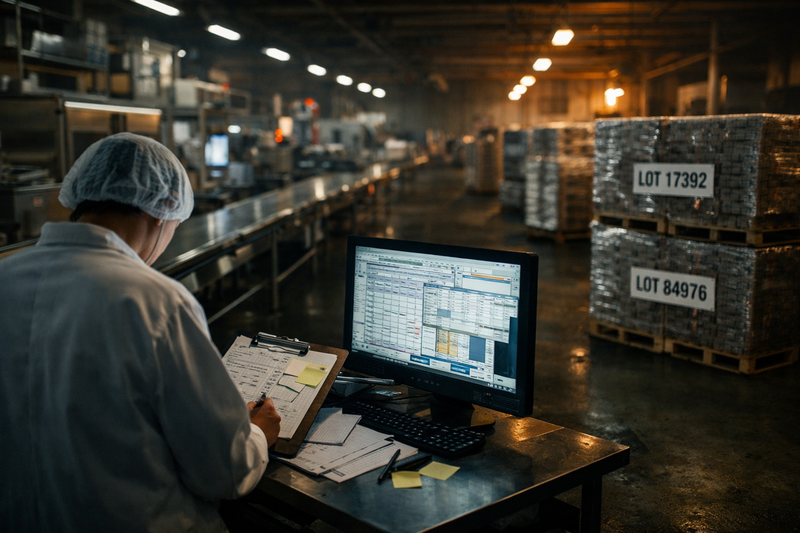
There’s a moment that separates confident operators from exposed ones, and it never shows up on a normal production day. It doesn’t appear when the line is running clean, when orders are shipping on time, or when inventory “looks about right.” It shows up the second someone asks a very simple question: “Where did this lot go?”
Most food manufacturers believe they’re traceable. They have lot codes. They label pallets. They keep logs. There are spreadsheets somewhere, maybe a clipboard near the line, maybe a shared drive with folders that feel organized enough. On a good day, it all seems to work. You can follow things if you have to. You can piece it together. You’ve done it before.
But that belief—that you can figure it out if needed—is where the real risk lives.
Because traceability isn’t something you prove when everything is going right. It’s something you prove under pressure, when time matters, when the question isn’t theoretical, and when the cost of being wrong compounds by the minute.
The illusion starts small. A batch of raw material comes in and gets assigned a lot. It’s used across multiple production runs. Some of it gets mixed into finished goods that are split across different orders. Some gets held back. Some gets repackaged. Notes get written. Quantities get adjusted. People remember what happened. It’s not chaos. It’s just not perfectly connected.
And that’s where “almost traceable” systems live—in the gaps between steps.
Everything feels manageable until you try to trace backwards and forwards at the same time. You can usually answer one direction. You can often answer it eventually. But the system doesn’t know. The system doesn’t guarantee. It relies on reconstruction, on memory, on digging through fragments of information that were never designed to connect in real time.
Then the phone rings, or the email comes in, and suddenly you’re not dealing with a routine question anymore.
A supplier flags a potential contamination issue tied to a specific lot. Or a customer reports a problem and gives you a finished product code. Now the question is immediate, and it’s not forgiving. You need to know exactly what was affected, exactly where it went, and exactly how contained the issue is.
This is where the difference between “almost traceable” and actually traceable becomes painfully clear.
In a manual or loosely connected system, the process turns into a scramble. You start pulling logs. You cross-reference spreadsheets. You check production notes. You talk to operators. You try to reconstruct the path of that lot through the system. Every answer leads to another question. Every gap forces a decision: do you assume it’s safe, or do you widen the scope?
And widening the scope is where the cost explodes.
If you can’t isolate exactly which finished goods were affected, you don’t recall a portion—you recall everything that might be connected. Product that was perfectly fine gets pulled anyway. Orders that didn’t need to be touched get included because you can’t prove they’re clean. The uncertainty becomes expensive very quickly, not just in product loss, but in time, labor, and trust.
People often think of recalls in terms of compliance, but the real damage shows up in how broad they have to be. The less precise your traceability is, the more you overcorrect. And overcorrection doesn’t just cost money—it erodes confidence. Customers don’t see the nuance of your internal process. They see disruption. They see uncertainty. They see risk.
At the same time, regulators don’t measure how hard you tried. They measure how quickly and accurately you can answer. “We’re still figuring it out” is not an acceptable state when traceability is on the line.
What’s deceptive is that none of this feels urgent until it suddenly is. You can run for years on systems that are “good enough,” because most days don’t demand absolute clarity. Most days allow for a little ambiguity. But traceability isn’t tested on most days. It’s tested on the worst one.
True traceability doesn’t rely on reconstruction. It doesn’t depend on someone remembering how a batch was handled or where a pallet ended up. It exists as a continuous, connected record from the moment raw material is received all the way through to the customer who received the finished product.
Every lot is tied to what it was used in. Every finished product is tied back to the exact inputs that created it. Every movement is recorded as it happens, not after the fact. When you need to trace something, you’re not building the answer—you’re retrieving it.
That difference changes everything.
Instead of asking, “Can we figure this out?” the question becomes, “How fast can we pull it up?” Instead of widening a recall because you’re unsure, you narrow it with confidence because the system already knows. Instead of burning hours chasing information, you spend seconds confirming it.
And that speed isn’t just convenience. It’s containment. It’s control. It’s the difference between a manageable incident and a cascading problem.
There’s a hard truth in all of this that most operations don’t confront until they’re forced to: if your traceability depends on effort, you don’t have traceability. You have a process that works until it doesn’t.
The uncomfortable test is simple. If someone walked up right now and asked where a specific lot went, could you answer completely, with certainty, in under thirty seconds? Not partially. Not eventually. Completely.
Because if the answer is no, then the risk isn’t hypothetical. It’s just waiting for the moment when it matters.