How PO Receiving Should Create Lot-Coded Inventory Automatically
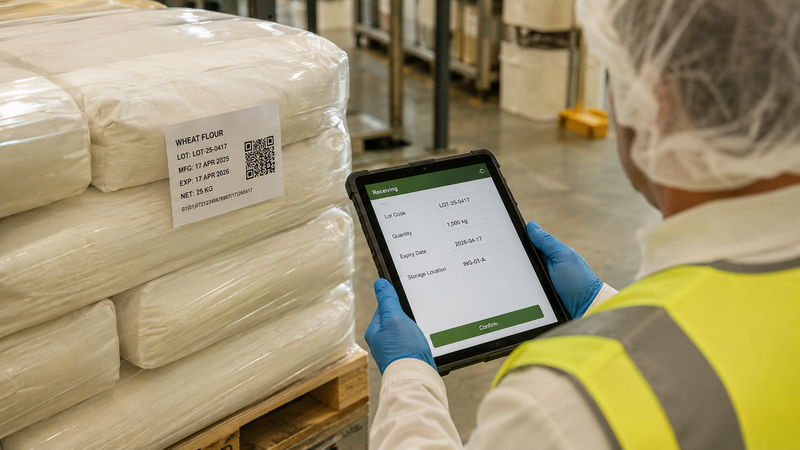
Receiving is where traceability begins. It is also where many food manufacturers quietly lose control.
A purchase order gets marked as received. Someone glances at a packing slip. Another person updates inventory. Lot codes, expiry dates, and storage locations get entered somewhere else later — usually by hand, usually under time pressure, sometimes from a phone photo taken on the dock. The material is physically in the building, but the digital record is incomplete.
That gap looks minor until the plant needs to answer a simple question: which exact lot came from which vendor shipment, where was it stored, and what finished product was it consumed in?
If your receiving workflow does not create lot-coded inventory automatically, you are asking your team to reconstruct traceability after the fact. That is not a process. That is damage control.
Why Receiving Is the Most Important Inventory Moment
Every downstream workflow depends on what happens at receipt. Manufacturing needs usable raw lots that can be picked and consumed. Quality needs supplier identity, lot code, and expiry information attached to the right material. Warehouse teams need location accuracy so pickers do not waste time hunting. Finance needs the PO and the inventory record to line up cleanly. Traceability — the system that protects your brand during a recall or an audit — needs the chain to start at the receiving dock, not be patched together a day later.
When receiving is disconnected from inventory creation, every one of those teams inherits the same problem: incomplete data at the exact moment the material becomes operational.
That creates a familiar set of symptoms:
- Raw materials show up as on hand, but not in a usable lot structure.
- Lot numbers get typed in later from memory or from a photo.
- Expiry dates are missing, inconsistent, or estimated.
- Warehouse placement is tracked on paper or on a whiteboard instead of in the system.
- Production has to walk over and ask receiving what actually arrived.
- COAs and vendor documents live in someone's email rather than against the lot.
None of this looks dramatic on the day of receipt. It becomes expensive when the plant is busy, when a lot must be quarantined, when a customer asks for proof, or when an FDA or SQF auditor wants to follow a finished good back to its raw inputs.
What Automatic PO Receiving Should Actually Do
A serious receiving workflow does not stop at confirming that a purchase order arrived. It transforms the receipt into usable inventory in one motion.
That means the system should, at the moment of receipt:
- Create the raw material lot record automatically, with no separate data-entry step.
- Capture the supplier lot code, internal lot identity, received quantity, and unit of measure.
- Store the received date, expiry date, and warehouse or storage location.
- Update inventory immediately so planning, production, and finance all see the same reality.
- Preserve the link back to the originating purchase order and vendor for full inbound traceability.
- Handle partial receipts cleanly, leaving outstanding quantities visible on the PO instead of forcing a workaround.
- Attach COAs and supporting documents to the lot, not to someone's inbox.
Once that happens, the material is no longer just "received." It is operationally real. It can be picked, consumed under FIFO or FEFO rules, audited, traced, and investigated without anyone filling in the blanks later.
How NovexERP Handles This
NovexERP was built for food manufacturers specifically, and its receive workflow is where its purchasing and inventory modules converge. When a PO is received in NovexERP, the system auto-creates a raw_material_lot record with the received quantity, unit of measure, received-at timestamp, storage location, and a direct vendor reference. The lot is linked back to its originating purchase order, so the chain from vendor → PO → lot exists from the first second the material is in the building.
A few details that matter in practice:
- Partial receipts work the way the dock actually works. Each PO line tracks
received_quantityseparately fromquantity, so the PO can sit inpartially_receivedstatus and still tell purchasing exactly what is outstanding. - Duplicate lots do not pile up. If a lot already exists at the same storage location, quantities merge rather than creating a second record to reconcile later.
- Every receipt creates a movement record. Inventory is not just a snapshot; it is an audit trail. Every change is logged with who made it, when, and why.
- PO events track the full timeline. Every status change — draft, ordered, partially_received, received, closed — is recorded with a timestamp and the user who performed it.
- Vendor cost is captured automatically. The vendor-material cost mapping updates
cost_per_uniton PO creation and receipt, feeding COGS analytics without anyone touching a spreadsheet. - COAs and documents attach to the lot. No more chasing the certificate of analysis through email when QA needs it.
The practical effect is that receiving becomes a single, complete action. The dock team enters the actual shipment details, confirms lot data, picks the storage location, and the rest of the operation inherits a clean record.
Why Food Manufacturers Need This More Than Generic ERP Buyers
In food manufacturing, raw inventory is not interchangeable. It has lot identity, shelf life, supplier history, allergen profile, and quality implications. A disconnect at receiving does not just create counting problems — it weakens the traceability chain before production even starts.
That is why manual receiving clean-up is so risky. Teams assume they will "finish the record later," but later often means after the material has already been moved, partially consumed, or pulled into an investigation. At that point, the system is no longer documenting the truth. It is documenting the best reconstruction someone can manage under pressure.
The operational consequence is subtle but serious: the plant starts relying on tribal knowledge to compensate for system weakness. Receiving knows one thing, the warehouse knows another, production trusts whichever answer comes back first, and quality builds its own side-spreadsheet to keep itself sane. None of those teams are wrong individually, but the system stops having a single version of reality.
The Financial Impact Is Bigger Than It Looks
This is not only a compliance issue. It is a margin issue.
When PO receipts do not convert directly into reliable lot-coded inventory, manufacturers lose time on reconciliation, create avoidable write-offs, miss expiry windows on material that was technically on hand but not visible, and make poor planning decisions because virtual inventory is unreliable. Purchasing thinks material arrived. Production thinks material is not ready. Finance sees receipts that do not line up cleanly with inventory movement. Each department is technically working, but they are not working from the same operational fact set.
The result is slower receiving, slower investigations, slower production response, and more time spent fixing records that should have been right from the start. None of that shows up as a single line item — it shows up as drag across every shift.
What Good Looks Like
The best receiving workflows feel boring, and that is the point. A user receives the PO, enters the actual shipment details, confirms the lot data, chooses the storage location, and the ERP does the rest. Raw material lots exist immediately. Inventory is updated immediately. The vendor-PO-lot link is preserved. The traceability chain begins immediately.
No duplicate entry. No handwritten side log. No second step that everyone forgets when the dock gets busy. No reconstruction project on Friday afternoon because the auditor is coming Monday.
If your current process still treats receiving and lot creation as separate jobs, it is worth raising your standard. Receiving should not create follow-up work. It should create inventory that the rest of the operation can trust — from the moment the pallet hits the dock, all the way through to the finished product on the truck.