How to Implement ERP Without Shutting Down Production
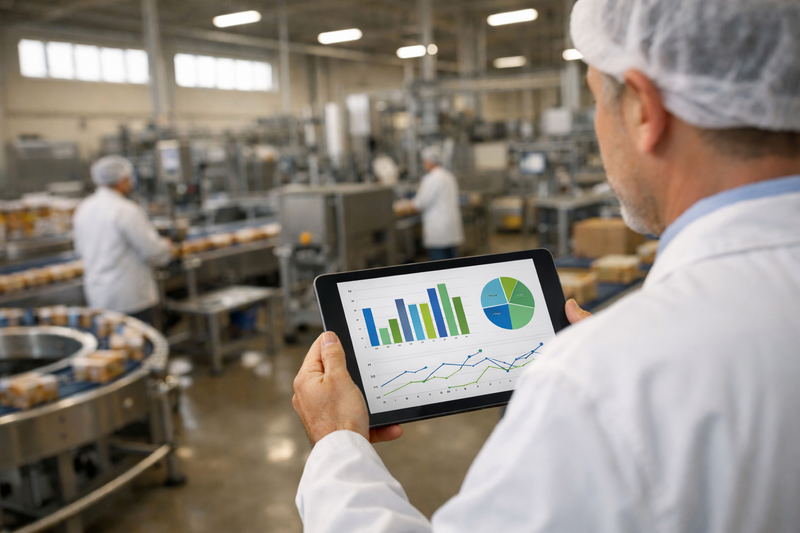
There's a moment in every food operation where things don't feel broken — but they stop feeling safe. Production is still moving, orders are still going out, inventory still exists somewhere. But the confidence is gone. You don't know what's on hand, you believe it. You don't see traceability, you assume it's there. You don't trust your numbers, you tolerate them.
That's the moment people start looking at ERP. And almost immediately, they hit the same wall: "We can't afford to disrupt production."
That fear is valid. Most systems touch everything — inventory, manufacturing, orders, compliance — and if something goes wrong during a transition, it's not a reporting issue. It's a production issue. But here's what's actually happening: it's not ERP that causes disruption. It's the way it's introduced.
The idea that breaks implementations before they start
Most companies approach ERP like a switch. They plan for a clean cut — a Monday morning where the old system ends, the new one begins, and everything is different. But that moment doesn't exist in real operations. Food manufacturing isn't a system you reboot. It's a continuous flow of raw materials, production, and outbound orders, with no pause button where you get to rebuild how everything works.
When implementation is treated like a full replacement, what actually happens is friction. People slow down, workarounds appear, and data gets skipped because production can't wait. And then the conclusion gets made: "ERP is too disruptive for us right now." When in reality, the approach was.
What implementation actually looks like on a production floor
When NovexERP is introduced correctly, nothing dramatic happens. There's no announcement, no shutdown, no "new system day." Instead, one thing quietly changes — maybe it's inventory. Instead of asking three people where something is, someone checks a screen. Instead of guessing quantities, they see exact lot-level numbers. Instead of reconciling at the end of the week, discrepancies surface immediately.
At first, it feels almost too small to call an "implementation." But something shifts. The answer comes faster. The argument disappears. The guesswork fades. And most importantly, production never stopped.
Why starting small is not a compromise — it's the strategy
There's a belief that ERP only works if everything is in it — full traceability, full production tracking, full order management, all at once. That belief is what makes ERP feel dangerous, because if everything has to change at once, then everything is at risk at once.
But that's not how real adoption works. What actually happens inside NovexERP implementations is much simpler: one process becomes reliable. Not perfect, not complete — just reliable. Inventory becomes something you can trust, or production logging becomes consistent, or order fulfillment stops relying on memory. That single point of stability becomes the foundation, not because someone decided it, but because the team feels it.
The moment the system becomes real
There's a very specific turning point in every successful implementation, and it's not when the software is configured, the data is imported, or training is complete. It's when someone on the floor stops asking another person — and checks the system instead. That's when ERP stops being "something we're trying" and becomes "how we operate." And that moment doesn't come from forcing usage. It comes from the system proving itself, quietly and repeatedly, in real situations.
Why running in parallel removes almost all risk
One of the biggest misconceptions is that ERP replaces your current system immediately. With NovexERP, both systems exist side by side for a period of time. The old way continues — whiteboards, spreadsheets, conversations — and alongside it, the system tracks the same reality. Not as a backup, but as a comparison.
This is where confidence is built. You start seeing where numbers diverge, where assumptions don't match reality, where problems used to hide. And because production never depended on a single source yet, nothing breaks. You're not risking operations — you're observing them more clearly than you ever could before.
Expansion doesn't happen on a timeline
Most ERP rollouts fail because they follow a schedule instead of behavior. "Week 1: Inventory. Week 2: Production. Week 3: Orders." That looks clean on paper, but it doesn't work in real environments, because people don't adopt systems on a schedule — they adopt them when they trust them.
With NovexERP, expansion happens when something simple becomes true: the team prefers using it. Not because they were told to, but because it's easier, faster, and more reliable. That's when it spreads — from one line to another, from one process to the next. Not as a rollout, but as a natural extension.
The part no one tells you: it will expose things
ERP doesn't create problems — it reveals them. Inventory that never actually matched. Production loss that was never tracked. Lot connections that were assumed but never verified. This can feel uncomfortable at first, because for the first time you're seeing the operation without filters. But this is also where the value is. Once something is visible, it can be controlled. And once it's controlled, it stops being a risk.
What "no disruption" actually means
It doesn't mean nothing changes. It means nothing breaks. Production continues, orders go out, the business runs. But underneath that, something more important is happening: the operation is becoming stable — no longer dependent on memory, on specific people, or on things "usually working." That's what ERP is supposed to do. Not replace your operation, but make it something you can finally trust.
Most food manufacturers don't fail because they can't produce. They fail because they outgrow their systems before they realize it. Everything works — until a recall, a large order, a rapid scale-up, or a compliance audit suddenly reveals the gaps. And by then, there's no time to implement anything safely.
ERP doesn't have to be a disruptive event. It can be a controlled transition — a series of small, proven improvements, a system that earns its place instead of forcing it. That's how NovexERP is designed to be implemented. Not as a switch. As a shift.