Most Incident Logs Fail Because They Don't Drive Corrective Action
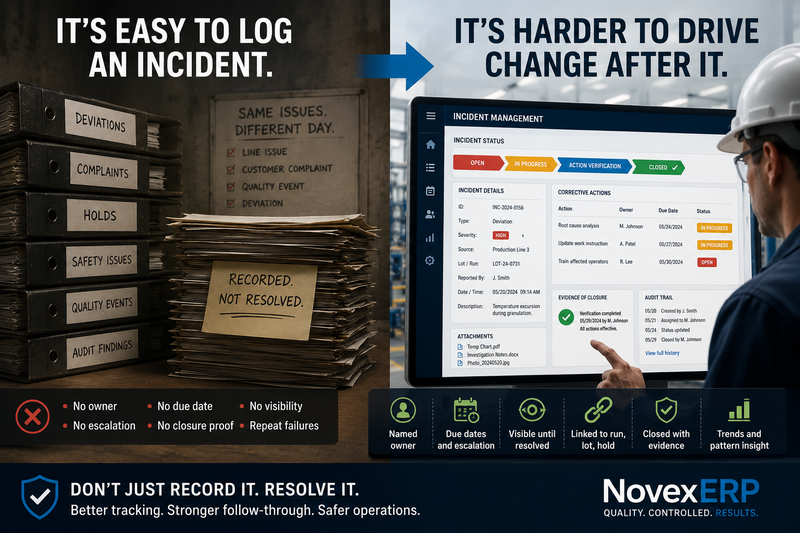
It is easy to build a place to record incidents. It is much harder to build a system that changes behavior after one is recorded.
That distinction matters. Many manufacturers can document a deviation, complaint, hold, or safety issue. Far fewer can show that the incident triggered corrective action, reached the right owner, stayed visible while unresolved, and closed with evidence instead of assumptions.
When that discipline is missing, incident management becomes a historical archive of problems instead of an operational control. The binder fills up. The plant does not necessarily get safer.
Documentation Alone Does Not Protect the Plant
A spreadsheet, shared form, or generic ticket queue can capture the fact that something happened. But an incident process fails if it does not answer the next questions automatically:
- Who owns the response?
- What action is required?
- When is it due?
- What evidence shows the issue was actually resolved?
- Can leadership see whether the same failure pattern is repeating?
If those questions are answered outside the system — in someone’s memory, a side conversation, or an inbox — then the system is not really managing the incident. People are. And people get busy, change roles, and forget.
Why Repeat Failures Keep Happening
The reason repeat failures survive is usually not that the first incident was invisible. It is that the follow-through was weak.
A line issue gets logged, but no one is assigned to root-cause work. A customer complaint gets recorded, but corrective actions are discussed in a hallway and never documented. A quality event sits open because there is no due date, no escalation, and no friction for letting it age quietly into irrelevance.
Over time, the organization starts calling this normal. Teams become good at recording issues and bad at eliminating them. The log grows; the underlying problem persists.
What Incident Tracking Should Actually Include
A real incident workflow needs structure — not because structure feels administrative, but because it prevents the issue from disappearing into email and memory.
At minimum, the system should support:
- Clear incident status progression from open to closed.
- Severity or priority, so high-risk events receive appropriate attention.
- Corrective actions with named owners and due dates.
- Attachments, notes, and linked evidence.
- An audit trail showing who changed what and when.
That combination turns the incident from a record into a workflow. This is the difference NovexERP is built to enforce: a deviation, complaint, or quality event is not a dead log entry but a tracked item with an owner, a due date, and a status that the organization has to actively move — linked to the run, lot, or product it came from, and, when warranted, to the hold or quarantine action it triggers. The organization can see not just what happened, but whether it is responding with discipline.
Why This Matters in Compliance and Operations
Incident systems are often discussed as compliance tools, and they are. But they are also operational tools. They reveal whether the plant is learning.
If incidents are closed casually, or if corrective actions are not tied to clear accountability, the organization sends itself a message: the important part is writing it down, not changing the process. That mindset shows up later as recurring deviations, customer dissatisfaction, and management reviews full of familiar problems.
Auditors notice this too. A mature incident process does not just prove that the company keeps records. It proves that the company can show response quality over time — that issues were owned, acted on, and closed with evidence rather than optimism.
Raise the Standard Beyond Logging
Incident logging is table stakes. The harder and more useful standard is this: once an incident is entered, the system should make it difficult for the organization to ignore.
That means visibility, ownership, due dates, escalation, and closure evidence. Without those pieces, the incident record may still look clean, but the operation is not actually under control.
If your current process ends at documentation, it is worth being blunt about the gap. You do not have an incident management system. You have an incident memory system. Those are not the same thing. The NovexERP pilot — a 60-day guided onboarding around your real quality workflows — is designed to close exactly that gap: to make sure that the moment an issue is recorded, the system starts pushing it toward resolution instead of just filing it away.