NovexERP BOM Builder: Smarter Bill of Materials Management for Manufacturers
From Spreadsheets to Systems: How NovexERP’s BOM Builder Brings Real Control to Production
In manufacturing, very few problems start on the factory floor. Most of them begin much earlier, quietly, inside planning documents, outdated spreadsheets, or half-remembered “standard” recipes that nobody has actually verified in months. When a production run fails, runs short, or costs more than expected, the root cause is almost always the same: unclear or inconsistent Bills of Materials.
For years, many growing manufacturers have relied on informal systems to manage their BOMs. A shared Google Sheet, a folder of PDFs, or a binder in the office might work when production is small. But as volume increases and teams expand, those systems collapse under their own weight. Versions get mixed up. Ingredients drift. Nobody knows which recipe is active. Costs become harder to track. Quality starts to vary.
NovexERP’s new BOM creation system was designed to solve this problem at its foundation. Instead of treating BOMs as static documents, it treats them as living, versioned, traceable production assets that connect directly to inventory, costing, and manufacturing workflows.
A Purpose-Built Interface for Production Teams
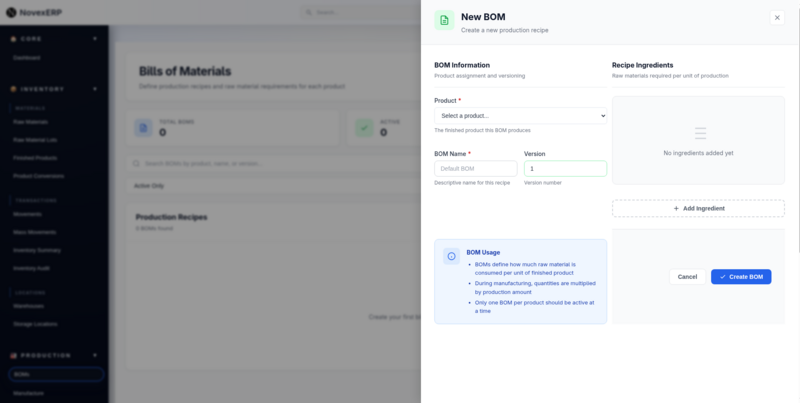
When you open the “New BOM” panel in NovexERP, you are not greeted with a maze of tabs and configuration menus. The interface is intentionally simple and divided into two main areas: BOM Information on the left and Recipe Ingredients on the right.
This layout reflects how production managers actually think. First, they define what is being made and how it is identified. Then, they define what goes into it.
By keeping these steps visually separate but connected, NovexERP reduces cognitive load and minimizes setup errors. Users do not need extensive training to understand what belongs where. The system guides them naturally through the process.
Product Assignment: Connecting Recipes to Reality
Every BOM in NovexERP begins with product assignment. The user selects the finished product that this recipe will produce. This is not a cosmetic choice. It creates a permanent relationship between the BOM and the product record.
Once assigned, the system knows exactly which recipe applies when that product enters manufacturing. Inventory consumption, cost calculations, batch planning, and reporting all reference this connection. There is no ambiguity about which formula is in use.
This eliminates one of the most common causes of production errors: running the wrong recipe for the right product.
Naming and Version Control That Actually Works
After selecting a product, the next step is defining the BOM name and version. These fields may look simple, but they represent one of the most powerful parts of the system.
A descriptive BOM name allows teams to understand the purpose of a recipe immediately. Whether it represents a standard formulation, a seasonal variant, a pilot batch, or a customer-specific configuration, the name communicates intent.
Versioning ensures that changes are never lost. Instead of overwriting old recipes, each update becomes a new, numbered iteration. This creates a historical record of how a product has evolved over time. If a new formula causes problems, teams can quickly identify what changed and revert if needed.
For companies dealing with audits, certifications, or regulatory requirements, this built-in traceability is critical. It turns BOM management from a risky manual process into a controlled system.
Ingredient Management: Precision at Scale
The Recipe Ingredients panel is where a BOM becomes operational. This section defines exactly which raw materials are required and in what quantities for each unit of production.
Each ingredient added represents a direct link to your raw material inventory. When production is scheduled, NovexERP multiplies these quantities by the batch size and calculates exact material requirements. During manufacturing, those materials are deducted automatically.
This precision eliminates guesswork. Teams no longer need to estimate how much material will be needed or manually reconcile usage after the fact. The system enforces consistency across every run.
The interface also makes it easy to add, modify, or reorder ingredients without disrupting the overall structure. Changes are intentional and traceable rather than accidental.
Built-In Guidance for Smarter Production
At the bottom of the creation panel, NovexERP provides contextual guidance explaining how BOMs are used throughout the system. This is not generic help text. It reinforces best practices and sets expectations for how recipes impact operations.
Users are reminded that BOM quantities represent per-unit consumption, that production automatically scales material usage, and that only one BOM should be active per product at any time. These rules prevent common mistakes that lead to inventory discrepancies and planning failures.
By embedding this guidance directly into the workflow, NovexERP helps teams build better habits without requiring formal training sessions.
From Planning to Execution Without Friction
Once a BOM is completed and saved, it becomes immediately usable across the platform. Production orders reference it automatically. Inventory transactions follow it. Cost-of-goods calculations depend on it. Reporting reflects it.
There is no manual handoff between planning and execution.
This seamless integration is what separates modern ERP systems from legacy tools. Instead of treating BOMs as reference documents, NovexERP treats them as operational drivers.
Every department sees the same data. Every calculation is based on the same source. Every batch follows the same rules.
Why This Matters for Growing Manufacturers
For small operations, informal BOM management often feels “good enough.” Problems are visible and can be fixed manually. But as production scales, those informal systems become liabilities.
Without structured BOM management, companies experience:
Rising material waste.
Unexplained cost increases.
Inconsistent product quality.
Inventory shortages.
Planning delays.
Audit failures.
These issues are not caused by bad employees. They are caused by weak systems.
NovexERP’s BOM builder replaces fragile processes with durable infrastructure. It creates a foundation that can support growth instead of fighting it.
Designed for Continuous Improvement
One of the most overlooked aspects of production management is iteration. Recipes change. Suppliers change. Processes improve. Markets shift.
NovexERP’s versioned BOM system is built for this reality. It allows companies to experiment, refine, and optimize without losing control. Every improvement is documented. Every change is measurable. Every outcome can be analyzed.
Over time, this turns production data into strategic insight.
Instead of asking, “Why are costs higher this year?” teams can ask, “Which formulation change caused this, and was it worth it?”
That is the difference between reacting and managing.
Building Reliable Production Starts with Reliable Recipes
At its core, NovexERP’s BOM creation system is about trust.
Trust that the recipe is correct.
Trust that inventory numbers are accurate.
Trust that costs reflect reality.
Trust that production will deliver what was promised.
When teams trust their system, they work faster, make fewer mistakes, and spend less time fixing preventable problems.
By turning BOMs into structured, versioned, integrated assets, NovexERP gives manufacturers that trust back.
And in modern manufacturing, that trust is everything.