One Inventory Ledger Across Shopify, Amazon, Walmart, and Faire
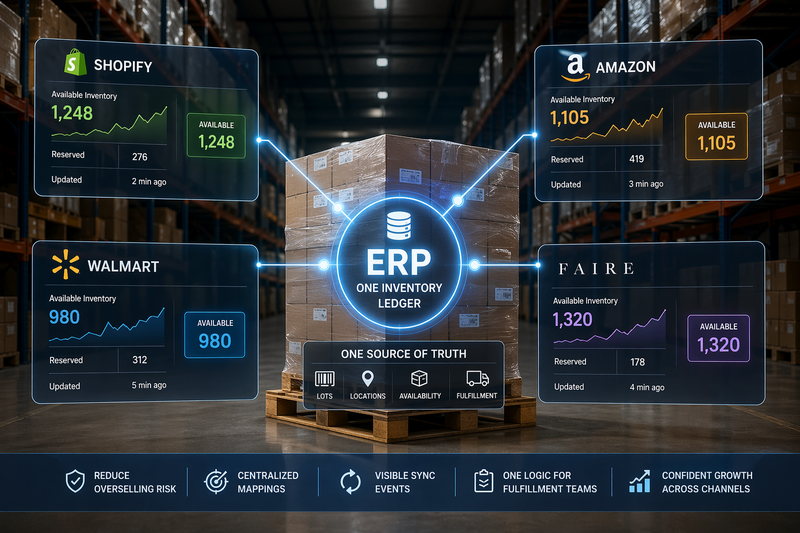
One Inventory Ledger Across Shopify, Amazon, Walmart, and Faire
Multi-channel growth sounds attractive—until each channel starts making its own promises.
Shopify shows stock one way. Amazon reserves it another. Walmart operates on its own timing. Faire adds another layer of marketplace logic. Before long, the business has four channels viewing the same inventory from four different angles, and operations is left reconciling the contradictions.
This is where many manufacturers realize they don't have multi-channel control. They have synchronized confusion.
Why Channel-by-Channel Inventory Fails
Separate channel logic creates risk because each marketplace starts behaving like its own source of truth. Even when quantities are technically synchronized, the operation still absorbs the mismatch whenever timing, mapping, or fulfillment assumptions differ.
The resulting problems are familiar:
- Stock gets promised twice across channels.
- Fulfillment teams stop trusting the numbers they see.
- Inventory adjustments in one system fail to propagate cleanly to the others.
- Customer service can't explain availability with confidence.
- Finance and operations end up reconciling different versions of reality.
These aren't marketplace quirks. They're symptoms of a missing inventory center of gravity.
The ERP Must Be the Ledger
For manufacturers, the ERP should serve as that center of gravity—not because it's convenient, but because it's the only system that understands inventory in operational terms. It knows product identity, lot structure, current availability, assigned stock, unit conversions, and fulfillment activity.
Marketplaces don't know any of that. They know what they were told about sellable stock at a given moment.
That's why the ERP has to remain the ledger, and the channels have to consume a disciplined representation of that truth.
What One Inventory Ledger Changes
When every channel draws from the same operational inventory record, manufacturers gain more than cleaner sync:
- Overselling risk drops because channels stop inventing inventory independently.
- Mappings can be managed centrally instead of ad hoc.
- Sync events and failures become visible and reviewable.
- Fulfillment teams work from the same stock logic as channel operations.
- Leadership can evaluate channel growth without losing inventory confidence.
Most importantly, channel expansion stops weakening control.
Food Manufacturing Raises the Stakes
In food manufacturing, inventory isn't just a unit count. It's lot-coded, location-sensitive, and often perishable. That means multi-channel inventory mistakes aren't simply customer service issues—they can create operational waste, recall complexity, and distorted planning decisions.
When four channels pull against the same stock without a disciplined ledger, the business adds risk every time sales volume grows.
Growth Needs a Better Foundation
The right way to think about multi-channel operations isn't "how do we keep all the channels updated?" It's "what system owns the truth that all channels should follow?"
For manufacturers, the answer should be clear: build around one inventory ledger in the ERP, and let Shopify, Amazon, Walmart, and Faire operate from that foundation. Otherwise, the company will keep growing sales volume while steadily weakening operational certainty.