Product Conversions for Food Manufacturing ERP | NovexERP
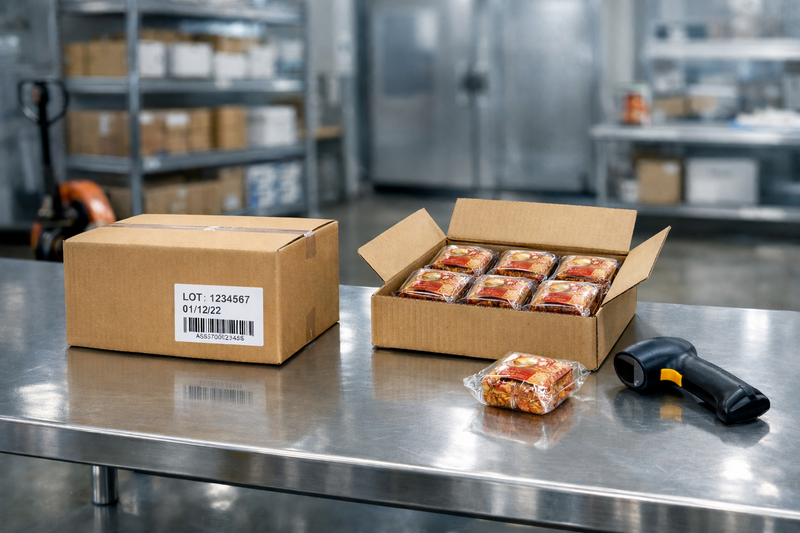
Product Conversions in NovexERP: Controlled Flexibility Without Losing Traceability
Anyone who's worked a day on a food manufacturing floor knows the reality: cases get broken down mid-shift to fulfill a partial order. Bulk product arrives from your co-packer and needs to be repackaged into retail SKUs before it ships. A customer changes their mind about case configuration three hours before the truck leaves. The production line runs short on one format, so you rebuild what you need from existing inventory.
These aren't edge cases. This is Tuesday afternoon in food manufacturing. The question has never been whether you'll transform products between formats — the question is whether your system can handle it without creating a traceability nightmare, breaking your inventory accuracy, or exposing you to compliance risk.
That's exactly what the Product Conversions module in NovexERP was designed to solve. It's not about preventing flexibility. It's about making flexibility accountable.
How Controlled Product Transformations Actually Work
Instead of forcing you into manual inventory adjustments every time you break down a case or rebuild a pallet, NovexERP lets you define conversion mappings between products. These mappings establish the mathematical relationship between a source product and a target product using a defined ratio. When you convert one case into eight retail packs, or consolidate eight retail packs back into a case, the system knows exactly what's happening and maintains full traceability through the transformation.
Each conversion mapping captures the source product, the target product, the conversion ratio, and whether the mapping is currently active. More importantly, it records a complete execution history every time someone uses that conversion. The system doesn't just know that conversions exist — it knows when they happened, who did them, what lots were involved, and where the inventory moved.
This is fundamentally different from the "just adjust it and we'll sort it out later" approach that causes so many problems during audits and recalls. You're not hoping the math works out. You're enforcing it at the transaction level.
Why This Matters Beyond Just Inventory Counts
In food manufacturing, you're not just tracking quantities. You're tracking lot codes that determine shelf life, production dates that define recall scope, and location history that proves cold chain compliance. When you break down a case of product without a structured conversion system, you're making a choice about whether that traceability survives the transformation.
Most small to mid-sized food manufacturers handle these situations by creating manual inventory adjustments, sometimes paired with a note in a spreadsheet or a sticky note on the warehouse manager's desk. The problem isn't that this approach can't work — it's that it doesn't scale, it creates audit exposure, and it absolutely falls apart the moment you need to trace contaminated product through your supply chain.
NovexERP's conversion system preserves lot-level traceability through every transformation. When you convert six-inch retail eight-count product into individual six-inch retail packs, the resulting inventory remains tied to the original production lot. The system records which source lot was consumed, how much was used, what target lot was created, where it came from, where it went, and who executed the conversion. If you ever face a recall situation, you can trace that path from original production through conversion to final shipment without gaps.
Ratio-Based Math That Actually Enforces Accuracy
The conversion ratio engine does something deceptively simple: it makes the math deterministic. When you define that one case converts to eight retail packs at a ratio of 1.00 to 8.00, the system calculates exactly how many units are created when you consume any quantity of the source product. There's no rounding chaos, no "close enough" estimates, no manual calculator sessions on the warehouse floor.
This precision matters because inventory accuracy isn't just about physical counts — it's about financial integrity. Your cost of goods sold calculations depend on accurate unit tracking. Your margin analysis requires consistent product flow. Your financial reconciliation process breaks down when conversions introduce unexplained variances. By enforcing ratio-based conversions, NovexERP ensures that the quantity consumed always matches the quantity created according to the defined relationship between products.
Physical Movement and Location Tracking During Conversions
Product conversions don't happen in some abstract inventory ledger. They happen in physical locations — chest freezers, staging pallets, specific warehouse zones. NovexERP captures both the "from" and "to" locations for every conversion execution. This means your digital records match your physical reality, which becomes critical when you're trying to demonstrate cold chain compliance or locate specific inventory during a quality investigation.
The system logs exactly where the source inventory was pulled from and where the target inventory was placed. If you're converting product stored in chest freezer location CF-12 and moving the resulting retail packs to staging pallet SP-2041, that movement is recorded with the conversion. You maintain warehouse discipline and pallet tracking accuracy even as you transform products between formats.
Managing Operational Control Through Active Status
Not every conversion mapping needs to be available all the time. Product configurations change, packaging formats get deprecated, and sometimes you need to prevent certain transformations while you're transitioning between systems or updating procedures. That's why conversion mappings can be activated or deactivated.
This gives you operational control over what transformations your floor staff can execute. You can disable outdated packaging configurations without deleting the historical record, prevent accidental misuse of old conversion ratios, and phase out product structures safely when you're introducing new SKUs. The system doesn't just record what conversions are possible — it enforces which ones are currently allowed.
Execution History as Your Audit Trail
Every single conversion creates a permanent record. The system captures the date and time, the source product and lot, the quantity consumed, the target product and lot, the quantity created, the movement locations, and the user who performed the action. This execution history becomes your audit trail for FSMA compliance, internal investigations, recall tracebacks, and financial analysis.
When an auditor asks where specific inventory came from, you don't reconstruct a story from memory or piece together notes from multiple systems. You show them the conversion history with complete transaction details. When you need to trace product for a recall, you can follow the chain from original production lot through conversions to final shipment. When you're analyzing operational efficiency or investigating shrinkage, you have timestamped records of every product transformation that occurred.
This is what audit-ready systems actually look like. The data exists because the system enforces its capture at the transaction level, not because someone remembered to document it afterward.
Why This Isn't Just Inventory Software
Product conversions in NovexERP support accurate cost flow, proper COGS tracking, and clean financial reconciliation. Because conversions are structured and ratio-based, they maintain the accounting discipline that separates real ERP systems from basic inventory software. You're not just tracking units — you're maintaining cost integrity through product transformations.
This matters when you're trying to understand your true production costs, when you're analyzing margin by product line, or when you're reconciling physical inventory to your financial statements. Informal conversion processes create unexplained variances that compound over time. Structured conversions keep your financial data clean.
The Real Problem This Solves
The most common mistake in small and mid-sized food manufacturing isn't refusing to adapt inventory to operational needs — it's adapting inventory without maintaining traceability and control. When product transformations are handled through informal adjustments and verbal agreements, you accumulate risk. Shrinkage becomes difficult to analyze. Inventory mismatches erode confidence in your data. Recalls become panic situations instead of controlled processes. Regulatory inspections expose weak points in your traceability.
Product conversions in NovexERP removes that fragility by making every transformation intentional and traceable. You maintain the flexibility you need to operate efficiently while building the documentation trail you need for compliance and accountability.
Built for How Food Manufacturing Actually Works
This module wasn't designed in a conference room by people theorizing about food manufacturing. It was built for warehouse managers who need to break down pallets to fulfill orders, production supervisors who rebuild cases when formats don't match demand, quality managers who need to protect traceability through every handling step, and owners who need to protect both margin and compliance.
The system acknowledges that inventory transformations are part of normal operations in food manufacturing, and it builds the necessary guardrails around those transformations without making them bureaucratic or difficult to execute. You can rebuild, break down, repack, and adjust — and every single action remains traceable through your lot tracking system, your warehouse management process, and your financial records.
That's what operational maturity looks like in food manufacturing software. Controlled flexibility. Complete traceability. Accounting integrity. The ability to adapt to real-world needs without sacrificing the documentation and discipline required for modern food safety compliance.