Shopify Orders Are Easy. Shopify Fulfillment Traceability Isn't.
Shopify Orders Are Easy. Shopify Fulfillment Traceability Isn't.
It is easy to celebrate a Shopify integration when orders start appearing in the ERP. That is the simple part.
The harder question is what happens next. Are products mapped cleanly? Are customers synchronized correctly? Does fulfillment status stay accurate? Most importantly for food and regulated manufacturers, do e-commerce orders remain inside the same lot-control and traceability rules as every other channel?
If the answer is uncertain, then the business has not solved the real integration problem. It has only solved order import.
Why Basic Shopify Sync Is Not Enough
Many integrations are designed around convenience. Pull the order. Push a status. Call it connected. That may work for lightweight retail workflows, but it is not enough for a manufacturer running real inventory control and traceability requirements.
As soon as volume grows, the gaps become visible.
- Catalog mappings drift from the ERP product structure.
- Customer records duplicate or fail to match cleanly.
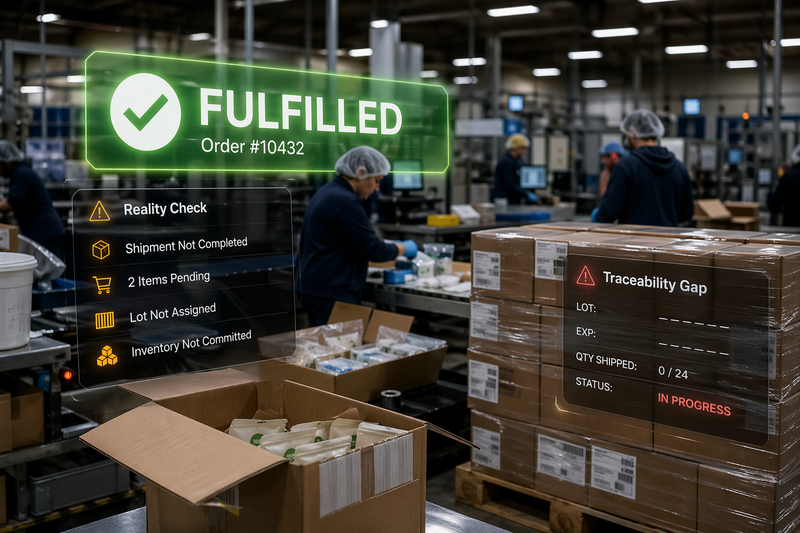
- Shopify says fulfilled while operations is still resolving the shipment.
- Inventory availability looks accurate in the storefront but not in production planning.
- Lot-level accountability becomes weaker in the e-commerce channel than everywhere else.
The Real Work Starts After the Order Lands
Once a Shopify order enters the ERP, it should become part of the same operational system as every other order. That means it should participate in inventory allocation, customer history, fulfillment tracking, shipment generation, and traceability without special exceptions.
This is where many teams discover that their integration is shallower than expected. The order exists, but the workflow around it is still fragmented. Operations must correct product mappings, customer service must reconcile customer identities, and fulfillment data moves out of sync as soon as the order leaves the simplest path.
What a Serious Shopify Workflow Should Include
A mature Shopify integration should do more than move data. It should preserve operational integrity.
That means supporting:
- Product mapping that aligns storefront items to ERP products accurately.
- Customer sync that does not create duplicate records and fragmented history.
- Webhook-driven updates so changes do not wait on manual refreshes.
- Fulfillment status that reflects what actually happened in shipping.
- Inventory and traceability workflows that treat Shopify as a real sales channel, not a side exception.
Why This Matters More for Food Brands
In food manufacturing, channel growth increases operational exposure. A direct-to-consumer or e-commerce order is still a lot-traceable shipment. If that channel sits outside the same inventory and fulfillment discipline as wholesale or manual orders, the company creates a hidden weakness in its control environment.
That weakness may not be obvious during routine volume. It becomes obvious during customer disputes, recalls, inventory shortages, or fulfillment investigations.
Connecting Shopify Is Not the Goal
The real goal is to make Shopify operationally trustworthy inside the ERP. That requires more than imported orders. It requires product alignment, customer consistency, fulfillment discipline, and traceability continuity.
If your current integration stops at "the order showed up," you have more work to do. For manufacturers, the operational truth of the order matters far more than the fact that it was imported.