Why HACCP Logs Should Be Connected to Production Runs
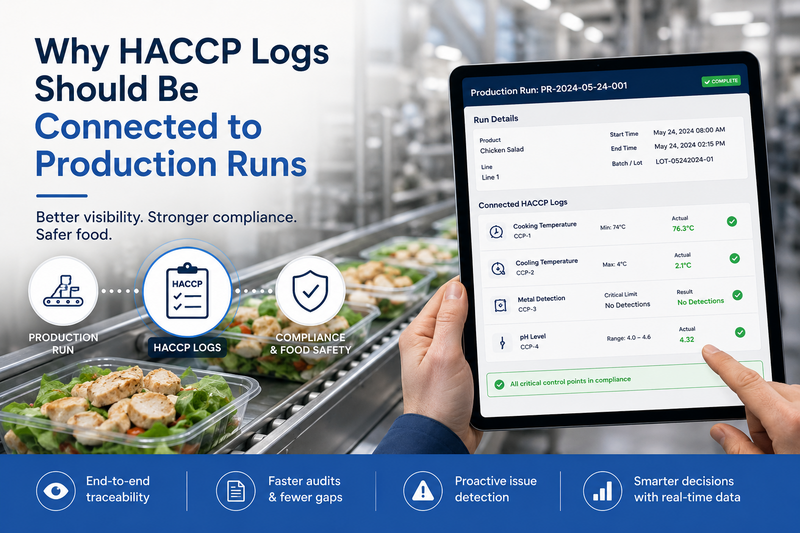
Food safety records lose value the moment they are separated from the work they are supposed to prove.
That sounds obvious, yet many manufacturers still capture critical readings, process checks, and deviations in forms or side systems that have little direct connection to the production run itself. The records exist. The signatures exist. But the operational continuity is weak. It takes investigation — matching timestamps, names, and batch sheets by hand — to connect the safety evidence back to the actual run, lot, and product.
In a regulated environment, that gap is not a filing inconvenience. It is the difference between a compliance story you can defend in seconds and one you have to reconstruct under pressure.
Disconnected Logs Create a Fragile Compliance Story
Traditional HACCP-style recordkeeping grew out of paper. Even when those records go digital, many plants keep the same architecture: one workflow for production, another for quality records, and manual effort to bridge the two. A clipboard becomes a PDF. A binder becomes a shared drive. The structure never changes.
That setup creates familiar problems:
- Readings are recorded, but not clearly tied to a specific manufacturing run.
- Deviation notes exist, but a supervisor cannot review them in production context.
- Investigations require cross-referencing timestamps and initials instead of following a linked record.
- Audit preparation becomes a reconstruction exercise instead of a query.
The plant technically has records. But the records are not as defensible — or as usable — as they should be. And the weakness only shows up at the worst possible time: during a recall, a customer complaint, or an auditor’s follow-up question.
Process Monitoring Should Live With Production History
The stronger model is straightforward. Capture process parameters, expected specifications, actual readings, and deviations in the same system that already knows the run, the lot, the product, and the production timing.
This is the principle NovexERP is built around. A critical control point reading is not entered into a standalone log — it is captured against the production run it belongs to, on the same record that carries the lot-coded inventory consumed and produced. The check, the spec, the reading, and the result all hang off one operational object.
That changes how people work. A quality manager can move from a reading straight to the run it belongs to. A supervisor can review an exception with full operational context — what was running, what materials were involved, who was on the line. An auditor can see not just that a temperature was recorded, but exactly how it relates to what was produced and where that product went. The record stops being a snapshot and becomes part of a chain.
This is what digital control should actually mean. Not replacing paper with screens, but making the safety record inseparable from the operational record.
Why This Matters During Deviations
Normal records are easy. Deviations are where system quality gets tested.
When a reading falls outside specification, the team needs to know immediately: which run is affected, what material is involved, who was responsible, and what product is now in question. If that information is split across separate tools, the response slows down at exactly the moment speed matters. Teams spend time navigating systems instead of evaluating risk.
When monitoring lives inside the production record, the path collapses. The deviation is already attached to the run, the lot, and the affected output, so the same event can trigger the next operational step — placing affected lots on hold, routing them into quarantine, and narrowing the exposure to the specific product instead of a guessed-at window. Containment becomes a function of the data you already captured, not a fire drill you start from scratch.
Good Compliance Systems Reduce Reconstruction
A useful way to judge any compliance workflow is to ask how much reconstruction it requires. If a manager has to piece together readings, production records, and lot history by hand to understand a single event, the system is doing too little of the work.
Well-designed process monitoring should reduce interpretation overhead. A reviewer should be able to move naturally from product to run to reading to exception to corrective action without ever leaving the record chain — and every step of that path should already be an audit trail, showing who recorded what and when. That is not just convenient. It is operationally safer, because the team spends its attention on the decision instead of on assembling the evidence to make it.
Food Safety Records Should Be Operational Records
Manufacturers should expect more from digital HACCP and process monitoring than storage. The real goal is a connected control environment where the plant can prove what happened — instantly — because the evidence was captured in context from the start, not bolted on afterward.
That is the standard NovexERP is designed to hold the plant to. Process checks, lot-coded inventory, deviations, holds, and traceability are not separate modules stitched together at audit time — they are the same connected record, updating as the work happens. When an auditor or a customer asks what happened on a run, the answer is a query, not a project.
If your safety logs still live beside production rather than inside it, there is an obvious next step. The NovexERP pilot is a 60-day guided onboarding built around your actual workflows — receiving, production, monitoring, and compliance — rather than a generic demo. The point is not to show you the software. It is to put it in the middle of how your plant already runs, capture your safety evidence in context, and let you decide whether the difference is real when it counts.