You Already Have FSMA 204 Compliance. You Just Don't Know It Yet.
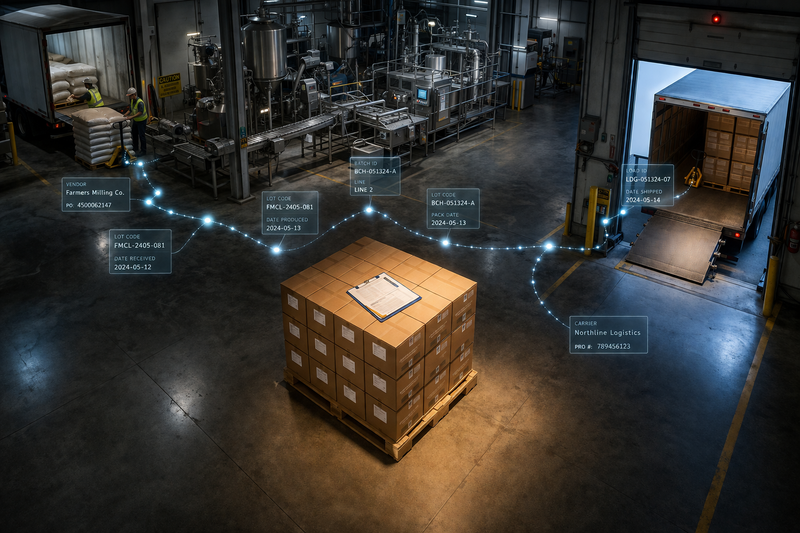
Somewhere right now, a food manufacturer is writing a check to a consultant. Maybe $50,000. Maybe more. The consultant is going to spend the next six months building a "traceability solution" that does one thing: connect the dots between where ingredients came from, what they were made into, and who received the finished product.
That manufacturer might not realize the dots are already connected.
What FSMA 204 Actually Requires
The FDA's Food Traceability Rule — Section 204 of the Food Safety Modernization Act — went into effect in January 2026. The language is dense, but the requirement is simple. For products on the Food Traceability List, manufacturers must maintain Key Data Elements at each Critical Tracking Event in the supply chain.
Translated into plain English, the FDA wants to know three things:
- What came in? Which raw materials, from which vendors, with which lot codes, on which date?
- What was made? Which finished products, using which raw materials, with which lot codes, when?
- Where did it go? Which customers received which finished product lots, and when was it shipped?
That's the entire rule. The FDA wants a chain. Vendor to ingredient to product to customer. And they want it produced within 24 hours of asking.
Most manufacturers hear "24 hours" and panic. But many of them — particularly those already running a modern ERP with lot-level tracking — may already have this chain without realizing it.
The Chain That's Hiding in Plain Sight
Consider what happens at a typical food manufacturing facility every day.
A delivery arrives. The receiving team logs the raw material, assigns a lot code, notes the vendor, and links it to a purchase order. That's a receiving event — the first Critical Tracking Event in the FSMA 204 chain.
The production team pulls those raw materials into a batch. They follow a bill of materials, record which ingredient lots they used, and produce a finished product with its own lot code and expiration date. That's a transformation event — the second link.
The shipping team assigns finished product lots to customer orders. They pick specific lots, generate a bill of lading, and the pallet goes out. That's a shipping event — the third and final link.
If a facility is recording all three of these events with lot-level detail, it has a complete traceability chain. Not a partial one. Not a "we can probably figure it out" one. A real, auditable, FDA-compliant one.
The problem is that most manufacturers don't think of their daily operations as compliance. They think of compliance as a separate initiative with its own budget and timeline. Meanwhile, the data they need is already flowing through the system they use to run the business.
Forward Trace: The Recall Scenario
A flour vendor calls. There's a potential contamination issue with a specific lot shipped three weeks ago. The clock starts.
In a facility with connected lot tracking, that raw material lot can be queried instantly to reveal:
- Which finished products were manufactured using that flour lot
- The specific lot codes of those finished products
- Which customer orders those lots were assigned to
- Which customers received them, with order numbers and ship dates
That's a forward trace. Instead of pulling product off shelves across an entire inventory, the scope is isolated to exactly which products were affected and exactly who has them. The difference between recalling 200 cases and recalling 20,000 cases is the difference between a manageable Tuesday and a company-threatening event.
The data to make that distinction doesn't require a new system. It requires a system that already connects receiving, production, and shipping at the lot level.
Reverse Trace: The Complaint Scenario
A customer calls about a quality issue with a specific product lot. The manufacturer needs to find the root cause.
A reverse trace starts from the finished product lot and works backward:
- Which bill of materials was used to produce this lot
- Which raw material lots were consumed during that production run
- Which vendors supplied those raw materials, and when they were received
- Which other finished products used those same raw material lots
This takes seconds in a connected system. Not hours. Not three spreadsheets cross-referenced with a handwritten production log. The connections already exist — the question is whether the system makes them queryable.
The Missing Piece Most People Overlook
Here's the part that catches most manufacturers off guard: the traceability chain doesn't end at the dock.
When shipping to a major distributor — KeHE, UNFI, or any retailer that requires EDI — traceability data needs to be embedded in the shipping documentation. Specifically, the EDI 856 Advanced Shipping Notice — the digital document that tells the distributor what's on the pallet before it arrives — should include lot codes and expiration dates for every item.
This is where many ERP systems break the chain. They track lots internally, but they don't push that data downstream in the format retailers and distributors require. The chain breaks at the last mile — not because the data doesn't exist, but because it doesn't travel with the product.
When the ASN includes lot-level detail, the chain is unbroken from vendor to end customer. The distributor can trace the product. Their retailers can trace it. And when the FDA asks anyone in that chain "where did this come from?", the answer is already in the system — no phone calls, no digging through emails, no guessing.
What Compliance Actually Looks Like
FSMA 204 compliance isn't a certificate on the wall. There's no audit to pass and forget about. It's an operational capability — the ability to produce a complete trace, in either direction, within 24 hours, whenever the FDA asks.
A manufacturer that can demonstrate all four of these capabilities is compliant:
- Raw material lots recorded with vendor source and receiving date
- Raw material consumption linked to finished product lots during manufacturing
- Finished product lots tracked through assignment to specific customer orders
- Lot codes included in outbound shipping documentation (ASN/856)
That's not a description of a compliance add-on. It's a description of how a well-run food manufacturing operation already works.
The Real Cost of Not Knowing
The food manufacturing industry has a habit of treating compliance as a separate project — something bolted onto existing operations with new software, new consultants, and new line items in the budget. But traceability isn't a feature to be added. It's a natural byproduct of running an operation that tracks lots at receiving, production, and shipping.
The manufacturers who are paying consultants to build "traceability solutions" may not need a solution at all. They may need someone to show them that the system they're already using — the one that runs their daily operations — already connects the three Critical Tracking Events the FDA requires.
The ones who understand this have a significant advantage. Not just in compliance, but in operations. Because the same chain that satisfies the FDA also reduces recall scope, accelerates root cause analysis, and gives customers and auditors confidence that questions can be answered before they finish being asked.
The chain is there. It's been there. The only question is whether anyone has looked at it that way.